



Dr. Abdel-Wahed El-Wakil is an Egyptian architect widely recognized as the contemporary world’s foremost authority on traditional Islamic architecture and vernacular masonry design. A two-time recipient of the Aga Khan Award for Architecture and the 2009 Driehaus Prize laureate, El-Wakil led a design counter-revolution that replaced steel-framed, glass-clad pastiche with load-bearing brick vaults, natural passive cooling, and sacred proportional systems.
The Philosophy: Beyond Nostalgia to Structural Integrity
While the 20th-century Middle Eastern oil boom triggered a surge in Western-style modernist skyscrapers and reinforced-concrete structures, El-Wakil argued that modernism stripped Islamic spaces of identity, thermal comfort, and spiritual presence.
Trained by the legendary vernacular pioneer Hassan Fathy, Abdel-Wahed El-Wakil expanded Fathy’s rustic mud-brick rural revival into high-monumental urban typologies. He proved that classical construction methods—catena arches, squinches, pendentives, and load-bearing masonry—could construct major urban landmarks without relying on reinforced concrete.
Core Architectural Tenets
- Pure Load-Bearing Masonry: El-Wakil replaced structural concrete skeletons with structural baked brick, stone, and traditional lime mortar. Concrete degrades rapidly in arid marine environments (such as Jeddah’s salt-laden air); load-bearing brick, under pure compression, lasts centuries.
- Passive Microclimate Modulation: Rather than defaulting to mechanical air conditioning, his designs integrate deep-set openings, central open courtyards (sahn), wind towers (malqaf), and wooden lattice screens (mashrabiya) to channel air currents and filter direct solar radiation.
- Sacred Proportional Logic: He applies dynamic Euclidean geometry, rooted in root-two and golden rectangles, creating volumetric harmony that echoes classic Mamluk and Ottoman traditions.
Landmark Masterpieces and Built Heritage
El-Wakil has built over 15 major mosques across Saudi Arabia, as well as landmark residential estates and public buildings in Egypt, the United Kingdom, and the United States. Across four decades of practice, Abdel-Wahed El-Wakil engineered structures using traditional geometric compressive vaults.

Al-Ruwais Masjid
1987
Jeddah, Saudi Arabia
Reintroduced traditional load-bearing brick craftsmanship to the Red Sea coast.
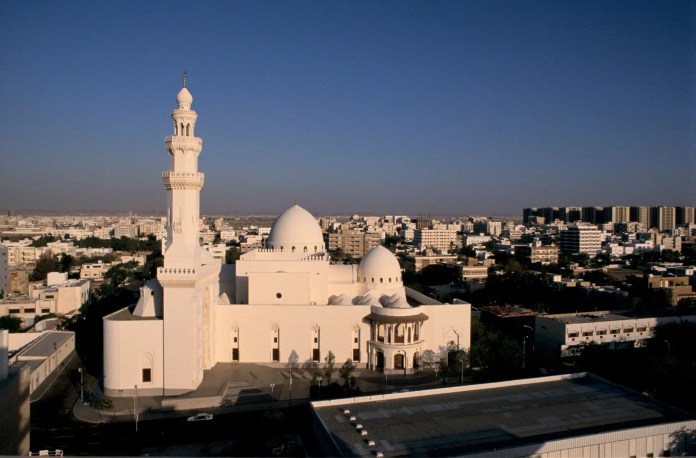
King Saud Masjid
1987
Jeddah, Saudi Arabia
A 20-meter brick dome built entirely without centering (falsework), engineered using structural brick compression.

Quba Masjid (Reconstruction)
1986
Medina, Saudi Arabia
A 20,000-capacity structural complex honoring the site of Islam’s first mosque.
2016
Oxford, United Kingdom
A hybrid synthesis of classic English collegiate Gothic and traditional Islamic brickwork.
Structural Comparison: El-Wakil Masonry vs. Modernist Concrete
| Dimension | Modernist Regional Typology | El-Wakil Vernacular Structuralism |
| Primary Material | Reinforced concrete frame + curtain glass | Fired red clay brick, limestone, lime mortar |
| Thermal Mass | Low mass; relies heavily on continuous HVAC power | High thermal mass; delays ambient heat transfer by 8–12 hours |
| Structural Physics | Tensile and bending stress (steel rebar vulnerable to chloride attack) | Pure compressive loads; no internal steel oxidation risks |
| Craft Dependency | Industrial machinery and standardized precast units | Local artisanal masons, carvers, and joinery craftsmen |
Why Modern Engineers Study El-Wakil
In modern sustainable architecture, the structural catalog of Abdel-Wahed El-Wakil serves as a masterclass in embodied carbon reduction.
- Embodied Carbon Reduction: By eliminating the energy-intensive clinker processes of standard Portland cement and structural steel frames, his masonry vaults achieve lower lifecycle carbon footprints.
- Bioclimatic Resilience: His spatial geometries anticipate desert heat spikes without mechanical failure points.
- Cultural Continuity: He avoided the superficial “orientalism” of gluing decorative arches onto concrete frames; his forms are generated organically by the physical needs of compression and ventilation.


